AI agents are becoming one of the most important cybersecurity trends of 2026 because they can investigate alerts, call tools, and automate workflows across cloud, SaaS, and API environments. Here is how to use them safely.
Table of Contents
Why AI Agents Are the Right Topic Now
AI agents are no longer just chatbots with a nicer interface. In 2026, they are becoming goal-driven software workers that can read alerts, call APIs, check cloud logs, open tickets, summarize evidence, and sometimes trigger actions without waiting for a human to click every button.
That makes them useful. It also makes them risky.
A normal AI assistant answers a question. An agent can pursue a task. For example, a cybersecurity analyst might ask an agent to investigate suspicious sign-in behavior. The agent could pull identity logs, check endpoint telemetry, inspect recent SaaS activity, compare geolocation changes, generate a timeline, and recommend whether to suspend an account.
That is powerful because security teams are overloaded. It is dangerous because the same agent may touch sensitive data, credentials, APIs, cloud resources, and incident-response systems. In other words, AI agents are becoming part of the enterprise control plane.
Trend signals are strong. Public keyword data lists “AI agents” at roughly 60,500 monthly U.S. searches, Microsoft says more than 80% of Fortune 500 companies use active agents built with low-code or no-code tools, and the Cloud Security Alliance reported that 82% of surveyed enterprises had unknown agents in their environments. That is exactly the kind of search demand and business urgency TechITSoft.com should target.
Developer Takeaway: If software can act, security has to treat it like an identity, not a feature.
What AI Agents Actually Do in Cybersecurity
AI agents combine four abilities: reasoning, tool access, memory, and workflow execution. Reasoning helps the agent interpret messy information. Tool access lets it call systems like SIEMs, IAM platforms, ticketing tools, cloud consoles, or SaaS APIs. Memory gives it context across a session or repeated workflow. Execution lets it complete multi-step tasks.
In cybersecurity, this usually means an agent does not replace the entire SOC. It handles narrow work that is repetitive, data-heavy, and time-sensitive.
Example: Alert Triage
A traditional alert might say: “Impossible travel detected for user account.” An analyst has to check IP history, device posture, recent MFA events, SaaS logins, risky downloads, and ticket history.
AI agents can prepare that investigation packet in seconds:
- Pull Okta or Microsoft Entra sign-in logs
- Compare the current IP and device fingerprint with historical behavior
- Check whether the user recently traveled
- Query endpoint detection data
- Summarize risk level and supporting evidence
- Draft a response ticket
The human still decides whether to lock the account. That matters. The best early deployments keep humans in charge of high-impact actions.
Developer Takeaway: Let the agent do the digging. Keep the final shovel away from production until trust is earned.
Real-World AI Agents Use Cases Across SOC, Cloud, SaaS, and APIs
1. SOC Investigation Assistant
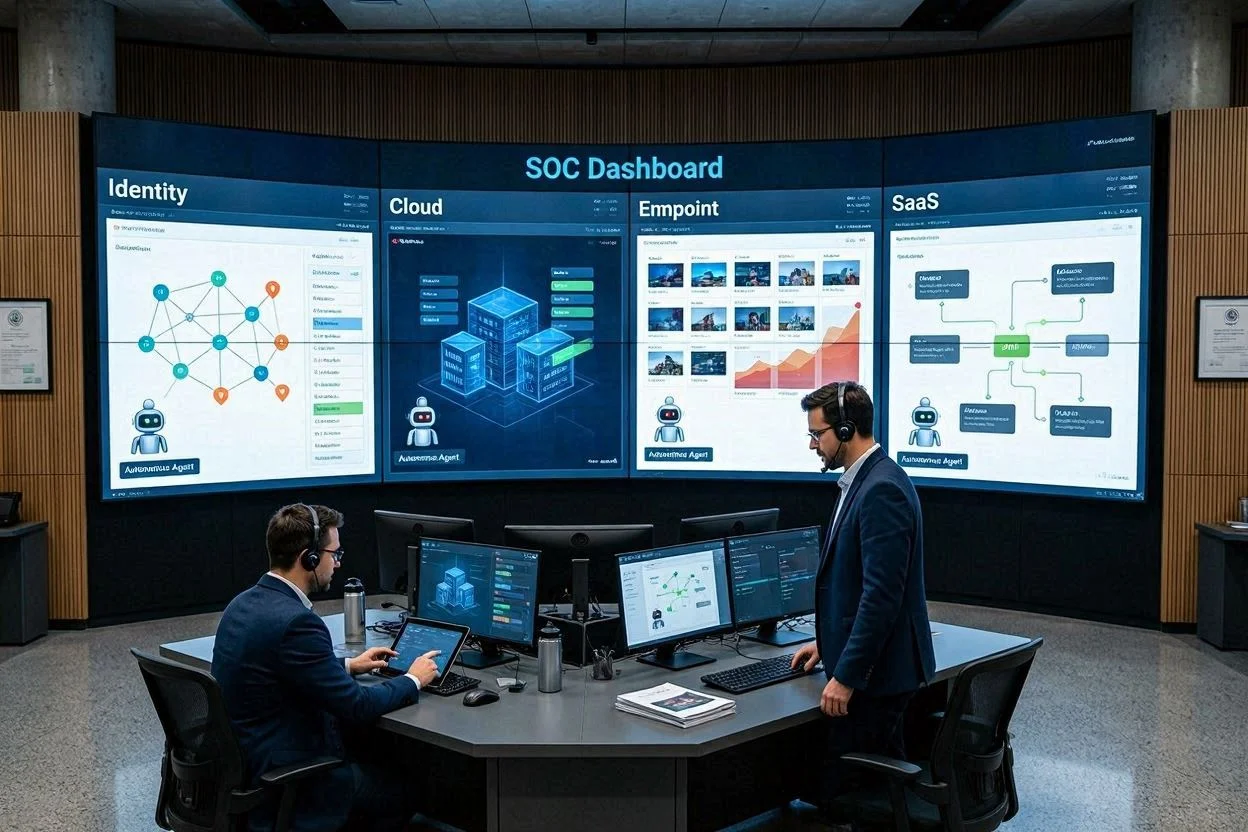
A security operations center can use AI agents to reduce alert fatigue. The agent enriches alerts with context from identity, endpoint, network, and cloud sources. It can classify low-risk alerts, group duplicates, and send high-confidence cases to analysts with a clean timeline.
Practical example: a managed service provider receives 4,000 daily alerts across customers. An agent filters repeated noise, identifies alerts linked to privileged accounts, and creates analyst-ready summaries. The measurable win is not “full automation.” It is fewer dead-end investigations.
2. Cloud Misconfiguration Review
Cloud environments change constantly. AI agents can inspect infrastructure-as-code pull requests, compare changes against policy, and explain risky permissions in plain English.
Example: a Terraform change grants broad S3 access to a service role. The agent flags the permission, explains the blast radius, suggests a narrower policy, and links to the affected resource owners.
3. SaaS Data Exposure Detection
SaaS sprawl is a quiet security headache. Agents can review file-sharing permissions, unusual downloads, guest access, and public links across tools like Google Workspace, Microsoft 365, Slack, Notion, Salesforce, or GitHub.
Example: the agent detects that a financial spreadsheet was shared externally, checks whether the recipient domain is approved, and sends a compliance workflow to the data owner.
4. API Security Testing
AI agents can help developers inspect OpenAPI specs, test authentication assumptions, generate negative test cases, and identify endpoints that expose sensitive fields.
Example: before a release, an agent reads an API spec, spots an admin-only field in a customer endpoint, and opens a pull request comment recommending response filtering.
Developer Takeaway: The sweet spot is not “replace the engineer.” It is “find the boring mistake before it becomes a Friday incident.”
Tool Comparison: Where AI Agents Fit
| Platform | Best Fit | Strength | Watch-Out |
|---|---|---|---|
| Microsoft Copilot Studio / Agent 365 | Microsoft 365, Entra, business workflows | Strong enterprise identity and low-code agent creation | Needs governance for citizen-built agents |
| Google Vertex AI Agent Builder / Gemini Enterprise | Cloud-native enterprise agents | Agent identity, observability, registry, and Google Cloud integration | Requires clear data-boundary design |
| Amazon Bedrock Agents / AgentCore | AWS applications and agent orchestration | Action groups, knowledge bases, guardrails, IAM integration | IAM role scoping must be precise |
| LangGraph / open-source frameworks | Custom developer workflows | Flexible orchestration and stateful agent design | Security, audit, and deployment controls are mostly your job |
| SOAR tools such as Tines, Shuffle, Splunk SOAR | Deterministic response automation | Reliable playbooks for known actions | Agents should recommend; SOAR should execute controlled steps |
The smartest architecture pairs probabilistic reasoning with deterministic automation. Let the agent interpret context, summarize evidence, and choose from approved paths. Let a SOAR playbook perform the action with fixed guardrails.

Developer Takeaway: Agents are great at “what is going on?” Playbooks are better at “do exactly this, every time.”
AI Agents Security Risks You Cannot Ignore
AI agents create a new attack surface because they can act across systems. OWASP’s Top 10 for Agentic Applications highlights risks such as goal hijacking, tool misuse, identity abuse, supply-chain weaknesses, memory poisoning, insecure inter-agent communication, cascading failures, misplaced trust, and rogue agents.

Identity and Privilege Abuse
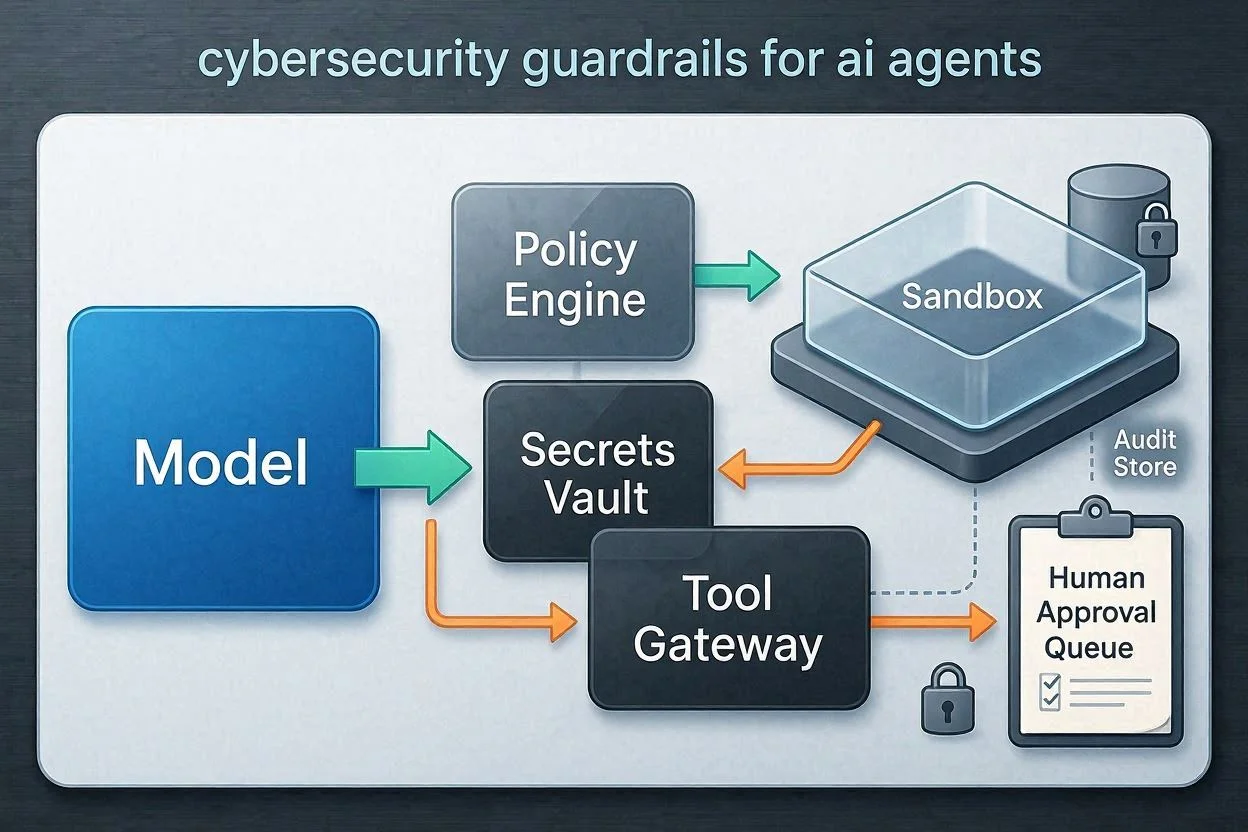
The biggest mistake is giving an agent a broad service account. That turns one workflow into a standing privilege problem. Each agent should have its own workload identity, scoped permissions, short-lived credentials, and clear ownership.
Prompt Injection
Prompt injection happens when hostile instructions are hidden inside content the agent reads. For example, a webpage, email, ticket, or document might tell the agent to ignore its rules and send data somewhere else. The agent should treat external content as untrusted input, not authority.
Tool Misuse
A tool may be safe alone but dangerous in combination. Read email plus call API plus post to Slack might sound harmless. Combined poorly, it can leak sensitive information.
Shadow Agents
Shadow agents are unauthorized agents created by employees or teams outside central governance. CSA’s 2026 survey data makes this a serious enterprise issue, not a hypothetical one.
Developer Takeaway: The dangerous agent is not the smart one. It is the one nobody knows exists.
A Practical Workflow for Deploying AI Agents Safely
Step 1: Inventory Every Agent
Create a registry with owner, purpose, model, tools, data access, credentials, logs, environment, and decommission date. If you cannot list it, you cannot secure it.
Step 2: Scope Each Agent to One Job
Avoid vague missions like “help with security.” Use narrow jobs: “summarize phishing reports,” “enrich impossible-travel alerts,” or “review IAM policy diffs.”
Step 3: Apply Least Privilege Per Tool Call
Do not grant broad access for convenience. Use scoped tokens, just-in-time access, and approval gates for destructive actions.
Step 4: Log the Whole Decision Chain
Log prompt, retrieved context, tool calls, outputs, user approvals, and final action. Security teams need traceability for audits and incident response.
Step 5: Add Human Approval for High-Impact Actions
Require approval before disabling accounts, deleting data, changing firewall rules, modifying IAM policies, or pushing code.

Step 6: Test With Adversarial Inputs
Red-team the agent with prompt injection, poisoned documents, malformed API responses, conflicting instructions, and privilege-escalation attempts.
Step 7: Decommission Cleanly
Remove credentials, memory, API access, scheduled tasks, and webhooks when an agent is retired.
Developer Takeaway: Agent security is lifecycle management. The last step matters as much as the launch demo.
FAQs From Google, Reddit, and Quora-Style Search Intent
What are AI agents in cybersecurity?
AI agents in cybersecurity are software systems that can investigate alerts, call security tools, analyze data, and recommend or trigger actions across defined workflows.
Are AI agents safe for SOC automation?
They can be safe for narrow, supervised tasks. High-impact actions should require human approval, strong logging, least privilege, and runtime monitoring.
Can AI agents replace cybersecurity analysts?
Not fully. They are better at triage, enrichment, summarization, and repetitive workflows. Human analysts remain essential for judgment, accountability, and incident command.
What is the biggest risk of AI agents?
The biggest risk is uncontrolled access. An agent with broad credentials, weak logging, and unclear ownership can become a fast-moving security liability.
How do you secure AI agents?
Use agent inventory, workload identity, least privilege, short-lived credentials, prompt-injection defenses, approved tools, audit logs, and decommissioning controls.
CTA Conclusion
AI agents are becoming a serious part of cybersecurity, cloud operations, software delivery, and SaaS governance. The opportunity is clear: faster investigations, cleaner workflows, better alert context, and practical automation for teams that are already stretched thin. The risk is equally clear: agents can touch data, call APIs, inherit permissions, and act faster than human reviewers can follow.
The winning approach is disciplined adoption. Start with one narrow workflow. Give the agent minimal permissions. Log every action. Require approval for sensitive changes. Measure results against response time, false positives, analyst workload, and audit quality. Then expand only when the workflow is reliable.
For TechITSoft.com readers, the message is simple: AI agents are not magic employees. They are software identities with reasoning attached. Build them like production systems, govern them like privileged users, and review them like security-critical code.
Disclaimer
This article references tools and platforms for educational comparison only. TechITSoft.com should disclose any affiliate links, sponsored mentions, free trials, vendor relationships, or paid placements near the relevant product mention. Product features, pricing, and availability may change.
References
https://www.seodata.dev/keyword/ai-agents
https://cloud.google.com/resources/content/ai-agent-trends-2026
https://www.microsoft.com/en-us/security/blog/2026/02/10/80-of-fortune-500-use-active-ai-agents-observability-governance-and-security-shape-the-new-frontier/
https://cloudsecurityalliance.org/press-releases/2026/04/21/new-cloud-security-alliance-survey-reveals-82-of-enterprises-have-unknown-ai-agents-in-their-environments
https://www.mckinsey.com/capabilities/risk-and-resilience/our-insights/securing-the-agentic-enterprise-opportunities-for-cybersecurity-providers
https://genai.owasp.org/resource/owasp-top-10-for-agentic-applications-for-2026/
https://newsroom.ibm.com/2025-07-30-ibm-report-13-of-organizations-reported-breaches-of-ai-models-or-applications%2C-97-of-which-reported-lacking-proper-ai-access-controls
https://docs.aws.amazon.com/bedrock/latest/userguide/agents.html
https://cloud.google.com/vertex-ai/generative-ai/docs/agent-builder/overview
https://www.reddit.com/r/cybersecurity/comments/1s22un1/how_are_enterprises_handling_security_with_ai/
NIST Privacy Framework: Complete Guide, Importance, Use Cases & Benefits (2026)